

REMINISCENCE OF A NATIVE
This blog has been triggered by a video I saw in circulation on WhatsApp groups, showcasing the backwaters of Kerala and the houseboats that have become an integral part of the region. I have an emotional connect with the region; this was where I was born and brought up, before, as an adult, I sauntered off to the army and the world beyond. They say that if you remember your home too much and too often in a conversation, you would end up a bore. But then I haven’t thought of my home for long, so my indulgence can be justified. Besides, I believe I have a story that can whet the reader’s interest.
Kuttanad, is what the region is called. Google says the name is derived from the word ‘Chuttanad’, which means ‘burnt place’ since the region was once a dense forest that was destroyed by wild fire. I am not quite convinced by the geological evidence quoted that black wooden logs were found buried under the soil. They could very well have been carried downstream from the forested mountains in the east. Be that as it may, there is a legend that cannot be substantiated by any such evidence: Beside a temple complex located by the bank of a canal, in a village called ‘Karumadi’, there exists a rock-carved, partly damaged statue under a concrete canopy (at least did exist when I was there more than half a century ago). No one knew whose statue it was and who put it up there, neither did anyone know when it happened to be put up. It was there as long as people remembered, may be not the canopy, which probably was constructed by some conservationist, who didn’t want the statue to be further damaged by rain. It had a marked similarity to a Buddha statue, and the more-educated lot believed that it could have been put up there by some Buddhist monks in ancient times, but that was just guess work (Of course, Google floats an alternative theory that the area was once a centre of Buddhism and hence was called ‘Buddhanad’, meaning Buddha Land that phonetically evolved into ‘Kuttanad’). The peasantry, who inhabited the village, never worshipped the statue, since it was different from any of the Hindu idols they did. Superstitious as they were of anything mysterious, none of them desecrated it either. So, it remained there, a forlorn enigma, which people called “Karumadi Kuttan”, ‘Kuttan’ being a common Malayalee pet name, which roughly translates to ‘the dear one’. Since the location of the statue was generally central to the region, people began calling the whole region ‘Kuttanad’, meaning the ‘Land of Kuttan’. Now, this is just a rural legend I have heard as a kid. Google could very well be right, but floating an alternative theory is always fun and I would rather stick to it.
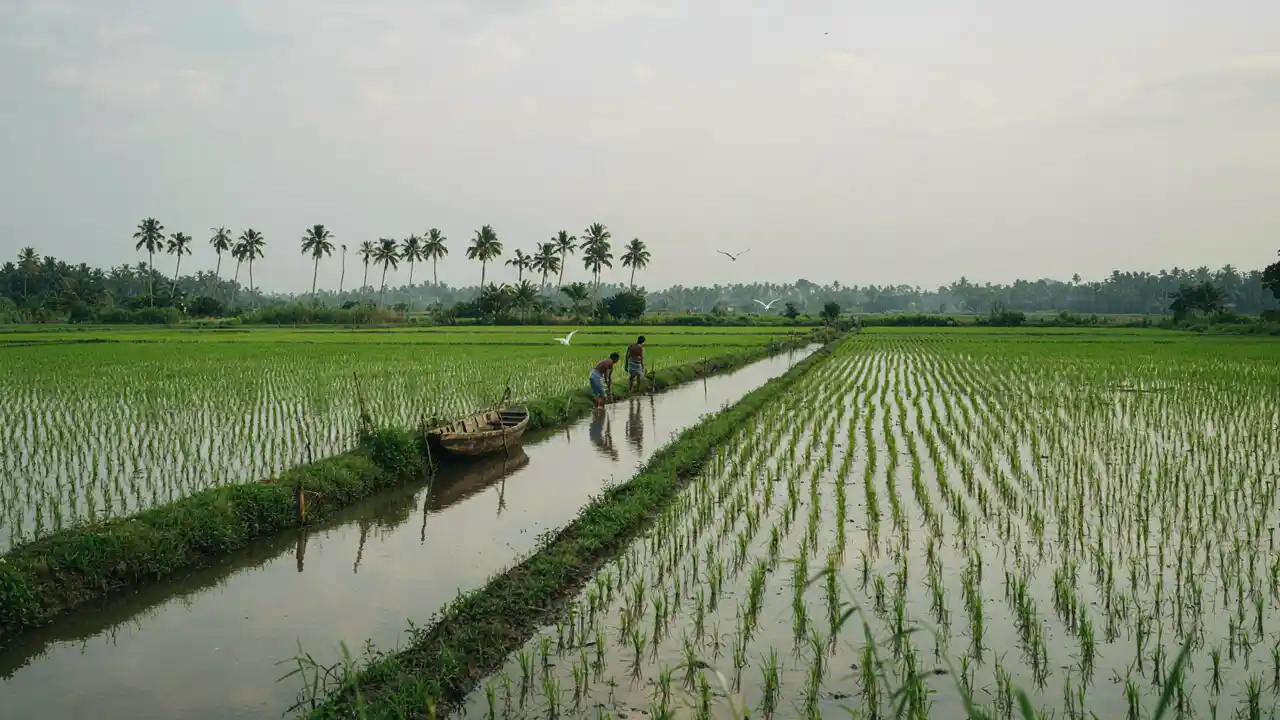
Now, let’s look at the topography, which is rather unique. Almost half of over a thousand square kilometres the region occupies falls under sea level, akin to Netherlands. The polder system of paddy cultivation the inhabitants follow, wherein canals and bunds crisscross vast expanses of lush green paddy, makes for a picturesque landscape. The two-crop cultivation also earned Kuttanad the recognition as the ‘Rice Bowl of Kerala’. Frequent floods that once ravaged the region is now kept under check by means of a spillway mechanism that expels excess water into the Arabian Sea. The unique topography renders the region abundant in waterbodies. Until about seventy-five years ago, scores of villages scattered over the region were accessible only by boats, and men, women and even children paddling small, wooden country boats, called Kochu Vallam-s or Kothumbu Vallam-s, solo across huge rivers was a common sight. Larger mid-sized boats, Kadathu or Palli Vallam-s functioned as ferries or passenger vessels that carried several people. There were also the much larger ‘Kettu Vallam-s’ or cargo boats, that traversed long distances carrying goods, or were used to carry mud dredged from riverbed.
The Chundan Vallam-s or the snake boats that race in the famous Vallam Kali-s, or boat races, the unique water sports events of Kerala, are a sight to watch in action. Ironically, these craft that entertains people today, originated as war boats in the era of feudal wars between the different kingdoms of the region. Almost 150 feet in length, the Chundan Vallam is a sleek vessel with a unique design of a pointed bow and a stern rising elegantly tall, built in present times for the singular purpose of racing. It can barely balance itself when unmanned, but on a race, carries over 100 rowers, besides five-odd helmsmen, a group of choristers led by a leader to maintain the Vanchi Pattu rhythm and a captain. These craft, often named after the villages that sponsor them, race neck to neck at incredible speeds and the races invariably end in photo finish. No wonder, Jawaharlal Nehru, India’s first Prime Minister, was so impressed the first time he watched one of these races that the now-famous Nehru Trophy Annual Boat Race was instituted with his blessings. Although there are several boat races in Kuttanad, the Nehru Trophy one, conducted at the Punnamada Lake near Alleppey, has become the most prestigious of all, for Government patronage. Incidentally, Punnamada is an extension of the larger Vembanad Lake, located adjacent to Kuttanad, stretching almost a hundred kilometres, and is the longest lake in India. Apparently, it is too vast and ocean-like to conduct a boat race on, because there is no place to put up spectator stands on, and Punnamada earned the honour. Inspired by the popularity of the boat races, some enterprising Malayalis wanted to join the Thames race with a Chundan Vallam and had built one for air transportation to London, but was dissuaded by the onset of COVID-19.
The story of water transportation in Kuttanad would not be complete without that of the motor boats people were once solely dependent on for long distance travel. For instance, there was a boat service between Alleppey, my sea-facing home town that bordered the region to the west, and the town of Kottayam that bordered it to the east, the journey taking a couple of hours. These services were originally maintained by private boat operators, until nationalized with the creation of KWTC, the Kerala Water Transport Corporation. When the service was private run, the boats had names by which people identified them. I remember a boat “Philomina” I travelled many times as a kid. Villages located by the riverside had jetties where the boats stopped over, for passengers to embark or disembark. It was altogether a different world, which has more or less vanished, with the development of road network. Road transportation has brought progress and prosperity to the region, but has robbed it of its tranquility and scenic beauty.
Ravaged by floods and crop failures, Kuttanad was also one of the poorest regions of Kerala once. The poverty was so intense that more than 600 young men from this geographically small region enlisted in the Indian Army during the Second World War, often a younger brother following his elder brother’s footsteps, after having had the news of the latter being killed in action. They had to keep their mother’s kitchen fire burning. Celebrated author Thakazhy Sivasankara Pillai’s short story “Katalassu Kappalukal”, (Paper Boats), made into a movie in recent times, poignantly paints the picture. A war-wounded veteran of the First World War, employed as a postman, who delivers letters and telegrams, heart-broken from becoming a hated figure for the innumerable ‘Killed-in-Action’ telegrams he delivers, chooses to make paper boats out of the telegrams and let them float away in the backwaters rather than delivering those.
Today, Kuttanad is a prosperous region, thanks to the tourism industry Kerala has cashed in on superbly with its ‘God’s Own Country’ tagline. Interestingly, the decline and revival of Kuttanad ran almost parallel to the changing fortunes of Alleppey, its traditional boat landing, the costal town located on its western periphery. Alleppey, in my young days, was a sleepy little town, generally collapsing and ignored. Why, we did not even have a rail connection, despite the fact that a direct line southward via Alleppey, parallel to the national highway, would have been much shorter, than the eastern line via Kottayam, which was put in place first. It was the tragic decline of a once proud town the Westerners had found worth calling the ‘Venice of the East’. It was the boat landing and seaport combined for the entire Kuttanad region. Two canals running parallel linked the backwaters deep into the town. All the paddy cultivated arrived here for transshipment to waiting ships by smaller seafaring boats that berthed at the town’s pier. The town was also the hub of the coir industry, with several multinational coir companies located in it. It was a thriving business centre, where trade unionism grew, turning it into a hotbed of communism. Alleppey even earned the sobriquet as Kerala’s (and India’s as well) ‘Moscow’. It has a bloody history of revolts, which is material enough to write a book about, and a martyrs’ memorial sits at the southern edge of the town. All that ended and Alleppey became irrelevant with the development of Cochin Port with berthing facilities for large ships and a railhead as well, robbing the town of all its business. It was the end of story for Alleppey and it went into ruins.
Not yet. Tourism proved a boon for the town. The humble Kettu Vallam-s, which carried clay from the riverbed, manually excavated in backbreaking effort for a pittance by poor labourers, for sand filling elsewhere, or laboriously traversed long distances carrying cargo, were suddenly transformed into their new avatars as houseboats. Houseboat cruises soon caught the imagination of the tourists, and it was not long before the houseboats assumed unimaginable proportions of being turned into 5-star entities, with even conference halls for corporates. Parallel with the explosion of the houseboat industry, tourist resorts sprang up all over Kuttanad along the banks of waterbodies. The quality of life of the rural folk, who once struggled for subsistence through farming, fishing or other related manual work, has improved astoundingly for the better, with new avenues of earning open to them as part of the tourist industry. And Alleppey aka Alapuzha naturally became the hub of all this revolution and found itself one of the most sought-after tourist destinations. It’s a grand turnaround I cannot but rejoice.




Excellent Article written in impeccable English. I can visualise the description as I too have somewhat similar background.
Kudos.
Thank you
God’s own Country described so beautifully. Pleasure to read and visualise.
Thank you.