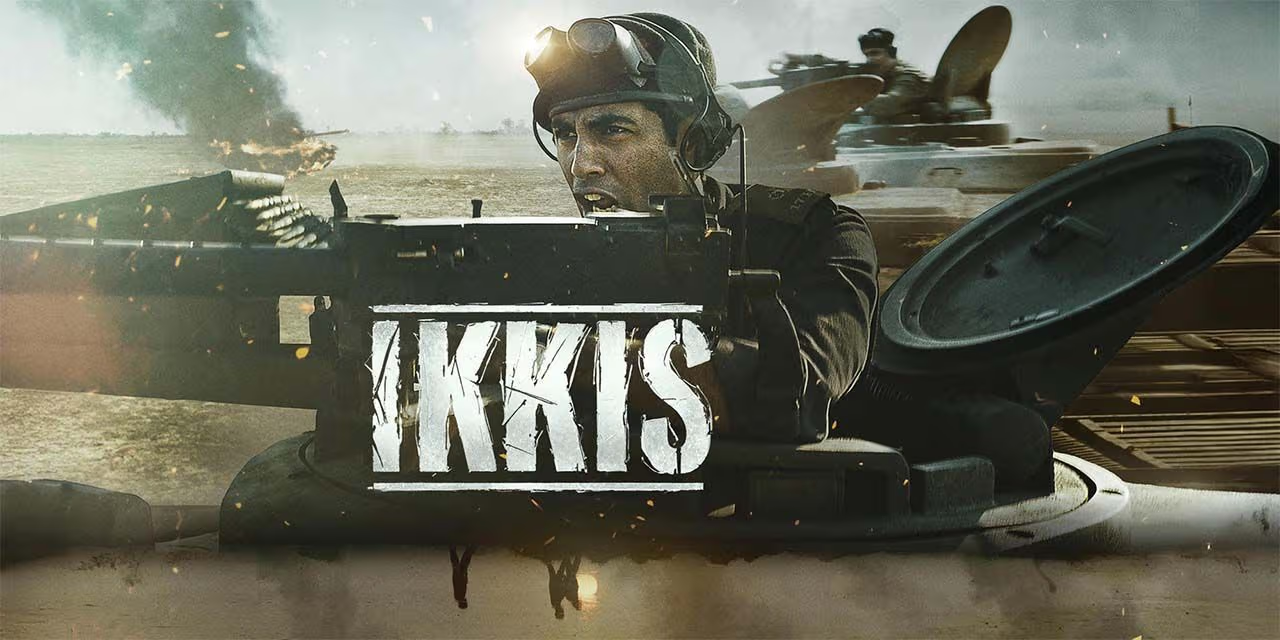

IKKIS – A movie that raises hopes on the future of Indian war movies
At the outset, one has to say that the movie, Ikkis, generates a lot of hope on the way Indian war movies are gradually evolving. Mercifully, it is void of the chest-thumping jingoism that characterizes Bollywood war movies to a fault and tells a story with appealing realism. The narrative, alternating between the nostalgic visit of the ageing father of the protagonist to his ancestral home in Pakistan and the grooming of the latter into a young officer and a tank commander, flows with finesse. Dharmendra, as the grieving father of Arun Khetarpal, leaves an outstanding last performance, matched equally by Jaideep Ahlawat, as the Pakistani officer, who fired the fatal shot that claimed Arun’s life, haunted by a feeling of guilt for having snuffed out a life so young. The screen presence of the duo, is the most memorable feature of the movie.
The story of Arun’s journey from NDA to Basantar, has been fairly well told. The performance by the two youngsters, Agasthya Nanda as Arun, and Simar Bhatia as his girlfriend, Kiran, is promising and heartwarming. The rest of the cast too has done absolute justice to their soldierly roles with decorum. The NDA part, however, could have been somewhat curtailed to make the movie crisper and shorter. Also, the scene depicting the revelry of the jawans, which has become a standard fare in all Indian military movies, could have been mellowed down, to maintain a distinctive aura of sobriety all along.
The makers of the movie, indeed, had the advantage of it being a biopic, a genre the Indian audience are inherently able to relate with, vis-à-vis full-fledged war movies that are seldom popular. Nevertheless, they have strived for authenticity to a great extent, most noticeably for the tanks depicted, Centurions with Indians and Pattons with Pakistanis. And the visuals of the tank-to-tank shooting was realistic and impressive, although occasional scenes of Indian tanks moving in a cluster and Pakistani tanks advancing line ahead (single file) under battle conditions could have been avoided with better supervision. Also, it would not have been out of place for the battle plan to be outlined briefly, for the sake of the audience, say by a briefing by the CO of the Poona Horse or so. Just by mentioning ’16 Madras’ or ‘Sappers’, the civilian audience does not follow what exactly is happening, viz, 16 Madras is establishing a bridgehead and the Sappers are clearing mines to create a lane for the tanks to advance and breakout from the bridgehead. Well-presented, even civilians are able to follow a battle plan, like the ‘Bridge Too Far’ proved, and outlining the story of the breakout of the Poona Horse in the Battle of Basantar would have taken far lesser space.
One stark anomaly that certainly should not have been there is the scene wherein a JCO addresses the young officers while smoking, with puffs of smoke emerging from his mouth. It would be outrageous for a JCO to do that, even if he has years of service behind him and the officers he is talking to are absolutely young and fresh out of the academy. ‘Friendly, not familiar’ is the phrase that sets the tone of relationship between an officer and other ranks. One can understand the director of the movie, being a civilian, not being aware of such nuances, but weren’t the army advisors or the reviewers at the AHQ, applying their minds at all? If it was supposed to generate humour, they have got it obnoxiously wrong!
All in all, despite the few-odd shortcomings, Ikkis is an eminently crafted movie on the life and times of one of India’s most inspiring war heroes. The producers deserve to be commended for a remarkable work done