
When Alleppey Kept Time Without Wristwatches
A Nostalgic Journey from the 1950s to the 1970s – Alleppey to the Army – and Beyond
Watching the Amazon Prime serial “Titan – Made in India”, about the making of India’s first quartz watch and the remarkable story of how India challenged the centuries-old dominance of Swiss watchmakers, set me thinking.
It took me back to the Alleppey of the 1950s – to the years when I was beginning to make some sense of the world around me.
Today, a wristwatch is almost taken for granted. In fact, for the younger generation, the watch as a timepiece has almost disappeared altogether. The mobile phone has taken over that job, and now the smartwatch has entered the scene – part chronograph, part mobile phone, and perhaps part personal assistant!
But there was a time when a wristwatch was a prized possession, a symbol of status and, for many of us, very much a luxury.
Alleppey – sans wristwatches
In our locality and family in those days, the only wristwatch I remember seeing regularly was my father’s West End – a beautiful rectangular, golden-cased Swiss watch with a matching chain and, proudly displayed on its dial, the words “10 Jewels.” It was a manual-winding mechanical watch.
For us children, Father’s watch was almost a forbidden object. Touching it was strictly prohibited. But whenever the opportunity presented itself and the watch happened to be lying unattended, we would quietly sneak up, pick it up and check the time.
Those few seconds of holding it in our hands gave us an inexplicable sense of privilege – as though we had temporarily acquired a piece of adulthood!
At home, fortunately, we had a large wall clock with a long oscillating pendulum. It had to be wound manually every day. Its most distinctive feature was its gong – a hammer striking a spring and announcing every hour with a deep, resonant chime that could be heard throughout the house, day and night.
But that raises an interesting question:
How did people keep time when hardly anyone owned a wristwatch?
The answer is fascinating. We had an entire network of clocks, bells, sirens, whistles, aircraft and even natural phenomena – none of them requiring batteries, chargers or Wi-Fi – which kept the whole town in rhythm.
Alleppey had its own timekeepers
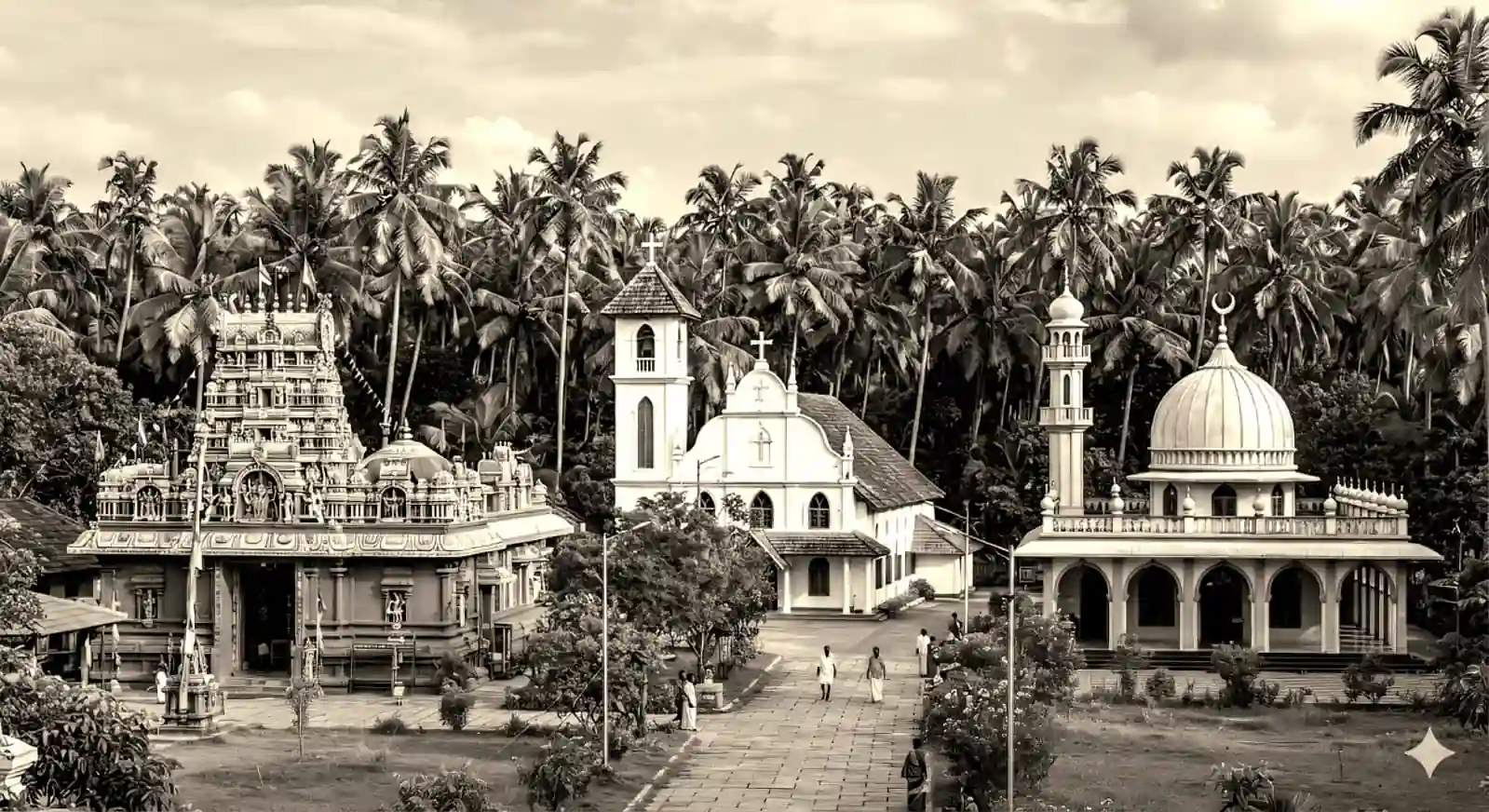
To begin with, there were temple bells and the kathina – those miniature cannon-like crackers whose explosions announced various temple rituals. There were church bells, and of course the baanku vili – the call to prayer at mosques at its prescribed intervals.
These were not merely religious sounds. They were part of Alleppey’s informal public timekeeping system.
One of my earliest memories of time was associated with a Dakota aircraft carrying The Hindu newspapers. Almost every morning, around six o’clock, the aircraft would fly past the Alleppey shoreline. Most people were already awake by about 5.30, and many of us would instinctively wait for the familiar drone of the Dakota to reluctantly shed the bed. The aircraft itself had become a morning time signal.
Then there was the siren from the Alleppey Municipality office, which sounded at intervals of two or three hours. People knew its pattern and instinctively used it to estimate the time.
Then the factories kept the town ticking.
Alleppey was then a thriving centre of the coir industry, with large British and German companies employing hundreds of people. Names such as Pierce Leslie, William Goodacre, Darrah Smail, Aspinwall and Madura Company were familiar landmarks of the town’s commercial life.
Their factory sirens formed another part of our informal timekeeping system. The sirens announced the beginning of work, recess, shift changes and the end of the working day. Each factory had its own rhythm, and the people of Alleppey knew the pattern almost as well as they knew the temple bells, church bells or azan from mosques.
The remarkable thing was that the system worked. Employees reported for work on time. Students reached school before the bell. Shops opened and closed at expected hours. Buses and boats arrived without anybody staring anxiously at a mobile phone. And, importantly, “I didn’t have a watch” was never considered an acceptable excuse!
The sun, the moon and the sundial
Long before watches became commonplace, people also looked upwards. The position of the sun or that of your own shadow provided a fairly reliable indication of the hour during the day. At night, the moon and stars served as natural companions for those who understood their movements. Even the rise and fall of the tides, transmitted through the backwaters into the hinterland, provided useful clues to the passage of time.
I still remember the sundial at SDV High School – reputedly one of its kind in South India.
To a child accustomed to clocks, a sundial seemed almost magical: time itself being measured by a shadow cast by the sun.
Today, a sundial might appear quaint. To us then, it was a living lesson in how our ancestors understood and measured time.
“What time is it?”
There was another little social custom that has almost disappeared. If you were fortunate enough to own a wristwatch, people passing by would frequently ask:
“Chetta samayam ethra aayi? “What time is it?”
Nobody seemed irritated by the question.
In fact, wearing a wristwatch and being asked the time was almost an acknowledgement of one’s modest affluence. The watch was not merely a timepiece. It was something worth noticing.
I became the proud owner of my first wristwatch when I went to college – a small German pin-lever watch.
It was certainly not as sophisticated as Father’s West End and, if memory serves me right, had an irritating habit of developing problems at precisely the wrong time.
But it was mine!
And that made all the difference.
It was also quite in order to display one’s watch prominently, with the wrist resting casually on a friend’s shoulder, in college group photographs.
That was not accidental.
That was watchman ship!
From College to Olive Greens
When I joined the Army towards the end of 1960s, the watch landscape had changed considerably. HMT watches were the preferred choice for many of us.
I still remember an HMT watch kept in a glass-topped box at the Unit Quarter Guard. The Guard Commander handled it with almost ceremonial reverence. The inspecting officers religiously check its serviceability and upkeep.
The hourly chimes, of the Quarter Guard bell goaded by this watch carried through the barracks became part of the rhythm of military life.
A few HMT Jawan watches were issued to key appointment holders and were treated almost as controlled items – not unlike the regiment’s rocket launchers and US wireless sets!
In the unit, watches were still not something everybody possessed. Apart from officers and certain key appointments, most soldiers did not have one. Yet the entire unit functioned with remarkable punctuality.
The Quarter Guard gong, the bugles – Reveille and Retreat – whistles and the calls of appointment holders were enough to keep everyone moving. Time was not something we carried on our wrists. It was something the whole unit lived by.
I also remember the Army Canteen in those days.
Watches were much in demand and often available only after a long wait. On one occasion, I bought an HMT Sona ladies’ watch for my sister. It cost me ₹150. My monthly salary then was a princely ₹400!
Looking back, I am not sure whether I was being generous to my sister or reckless with my finances. Perhaps both.
And then came Titan – Made in India.
Suddenly, watches became more accessible, more stylish and more aspirational. The watch was no longer merely an instrument for measuring time. It became an expression of personality, taste and, occasionally, one’s ability to impress others.
Swiss watches continued to command enormous prestige – and their prices reflected it.
But HMT and Titan brought something different: a good watch within the reach of ordinary Indians. Eventually, quartz technology transformed the watch itself.
The humble mechanical watch, which had demanded winding and care, was gradually replaced by something that seemed almost miraculous to us: A watch that kept time without being wound!
That was progress.
What we gained – and what we lost
Looking back today, the journey from Father’s hand-wound West End to HMT, and from HMT to Titan and quartz watches, is much more than the story of a gadget.
It is, in many ways, the story of changing India.
In the 1950s, we did not need a watch to tell us every five minutes what we were supposed to do.
The town itself kept time.
Today, we have a clock on the wall – perhaps in every room. A watch on the wrist. A clock in the car. A computer on the desk. A mobile phone in the pocket. And, for good measure, a smartwatch on the wrist.
Yet we still receive reminders telling us when to wake up, when to leave, when to attend a meeting, when to take a break and, occasionally, when to go to bed.
Perhaps the greatest irony is that we have never had so many ways of knowing the time – and yet seem to have less time than ever before.
For those of us who grew up in the Alleppey of the 1950s, a wristwatch was not merely something that told us what time it was.
It told us something about who we were, where we had arrived in life, and how far the world had travelled.
From a Dakota flying over the Arabian Sea to a smartwatch receiving messages from satellites, the journey has been extraordinary.
And yet, somewhere in that journey, something has quietly disappeared.
We no longer listen for the factory siren.
We no longer wait for the Dakota.
We no longer calculate the hour by the position of the sun.
We certainly don’t ask the gentleman wearing a watch, “What time is it?”
And perhaps that is why, even today, the memory of Father’s old West End remains more precious than any watch I have worn since.
It did not merely keep time.
It kept a piece of my childhood.